-
Great Wall
Photograph by Justin Guariglia
China’s most rural reaches retain their beauty and mystery even as the countryside and its people are touched by the rapid pace of industrialization.
Writhing like dragon tails, the Great Wall is not one structure but many. Most of what is called the Great Wall was built during the 14th-century to 17th-century Ming dynasty. The total length of the walls is unknown, though the sections built by the Ming alone would stretch from Washington, D.C., to Wichita, Kansas.
-
Grandmother and Baby, Guizhou Province
Photograph by Lynn Johnson, National Geographic
Toughened by a lifetime of fieldwork, the hands of a za, or elder woman, provide loving care for her grandson, who wears a traditional hat adorned in silver.
-
Brick Factory, Hebei Province
Photograph by Yongping Chen, My Shot
A woman hauls bricks at a factory in Hebei Province. The movement of able workers from the countryside has turned China into the world’s factory floor.
-
Rice Terraces, Yunnan Province
Photograph by Thierry Bornier, My Shot
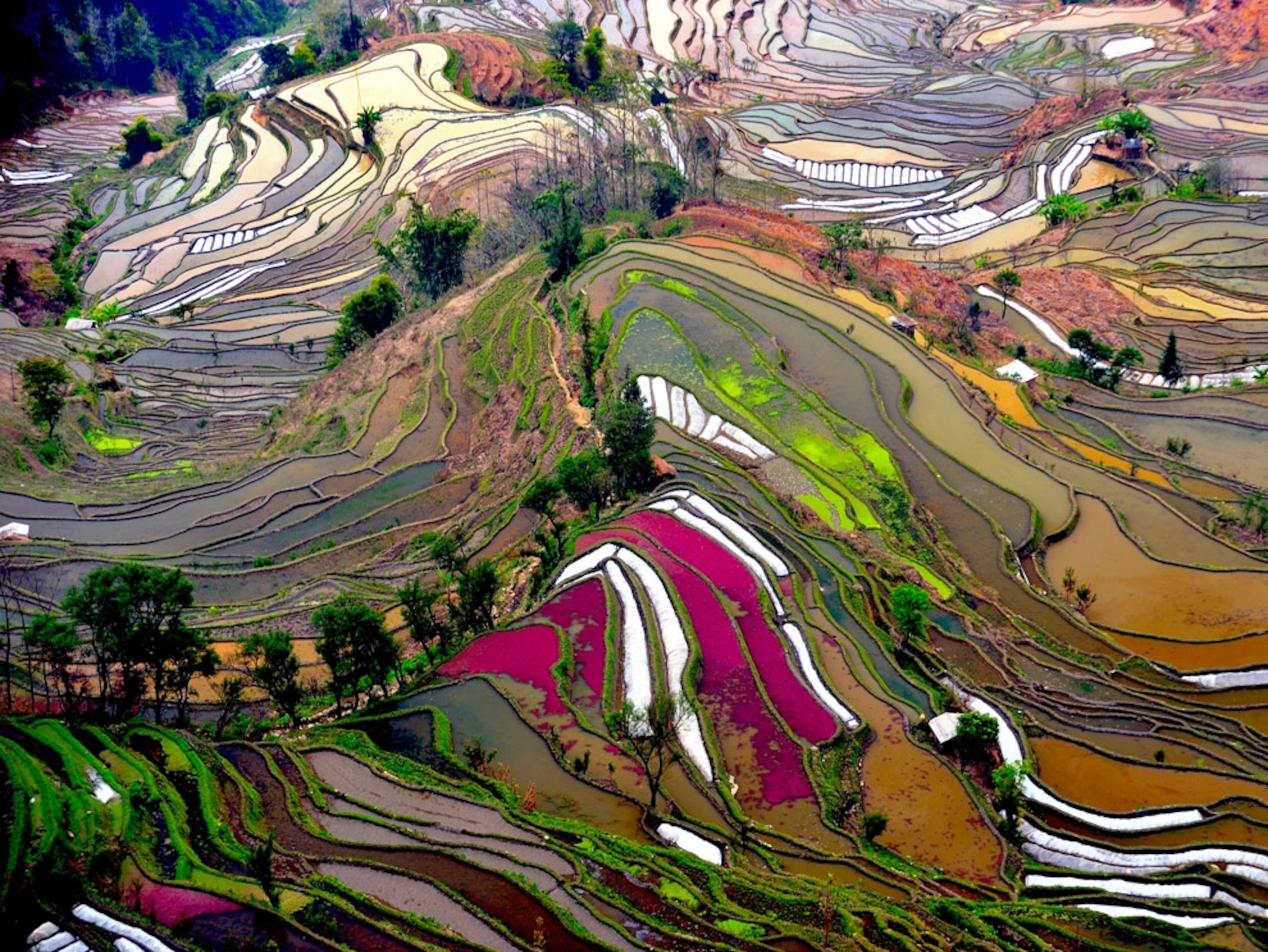
Rice terraces resemble stained glass in Yunnan Province in southern China, where human activities began with the reshaping of hillsides into grand staircases of grain. Rice stubble left to decay in the field, manure, and fish raised in the paddy water all add nutrients to the area’s soil.
-
Buddhist Monk, Tibet
Photograph by Maria Stenzel
Sunlight and devotional lamps lit by a Buddhist monk illuminate the interior of the Jokhang Temple in Lhasa, Tibet. Inside the massive temple are some of Buddhism's most important icons, including the famed Jowo Rinpoche statue—a seated Buddha installed when Buddhism was adopted by Tibetan royalty in the seventh century.
-
Festival Dance, Tibet
Photograph by Justin Guariglia
Men dance in traditional dress at a festival in Tibet. The high plateau west of China’s heartland was once a Tibetan kingdom. After centuries of shifts in political power, China took control in 1959 and created the Tibetan Autonomous Region in 1965.
-
Farmers, Jiangxi Province
Photograph by Robert McCammon, My Shot
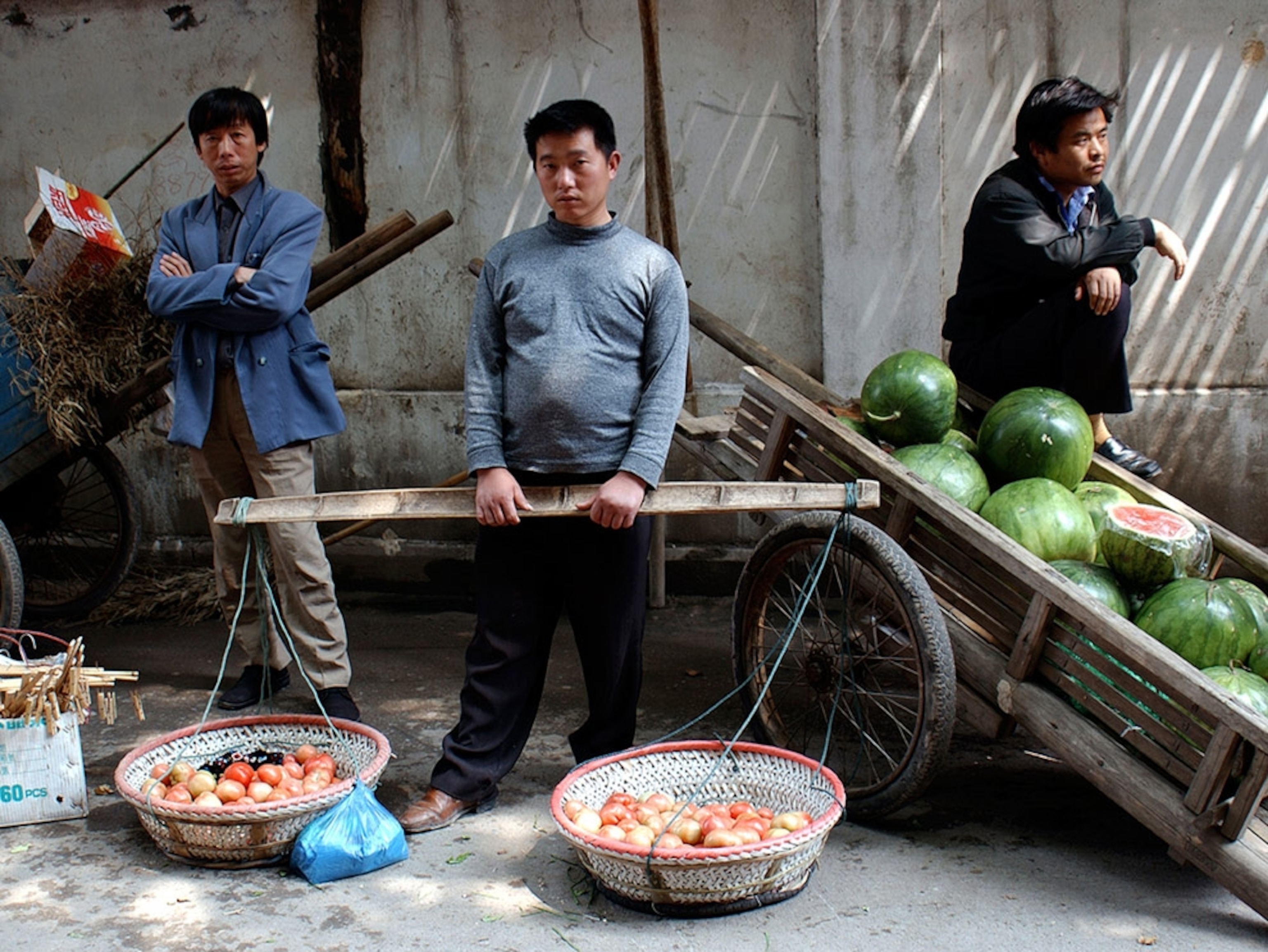
Farmers sell produce in Jiujiang, a city located south of the Yangtze River in Jiangxi Province. Water from the Yangtze must support both industry and family farms.
-
Shipton’s Arch, Taklimakan Desert
Photograph by Gordon Wiltsie
A climber navigates a slot canyon below Shipton’s Arch, a geological wonder found by famed British explorer Eric Shipton in the mid-20th century. Located in the Taklimakan Desert in western China, the arch is 25 miles (40 kilometers) from Kashgar, once among Britain’s most remote diplomatic posts.
-
Terra-Cotta Warriors
Photograph by O. Louis Mazzatenta
A great terra-cotta army was buried to accompany China’s first emperor, Qin Shi Huang Di, in the afterlife. More than 2,200 years old, the lifelike statues have fascinated archaeologists since their discovery near Xi'an in China’s Shaanxi Province.
-
Giant Panda, Sichuan Province
Photograph by Fritz Hoffmann, National Geographic
Soaking up afternoon sun, a young male panda munches bamboo provided by keepers at Wolong Nature Reserve in Sichuan Province. All but one of Wolong’s 63 captive pandas survived the devastating earthquake that rocked central China in May 2008.
-
Brahmaputra River, Tibet
Photograph by Tao Images Limited
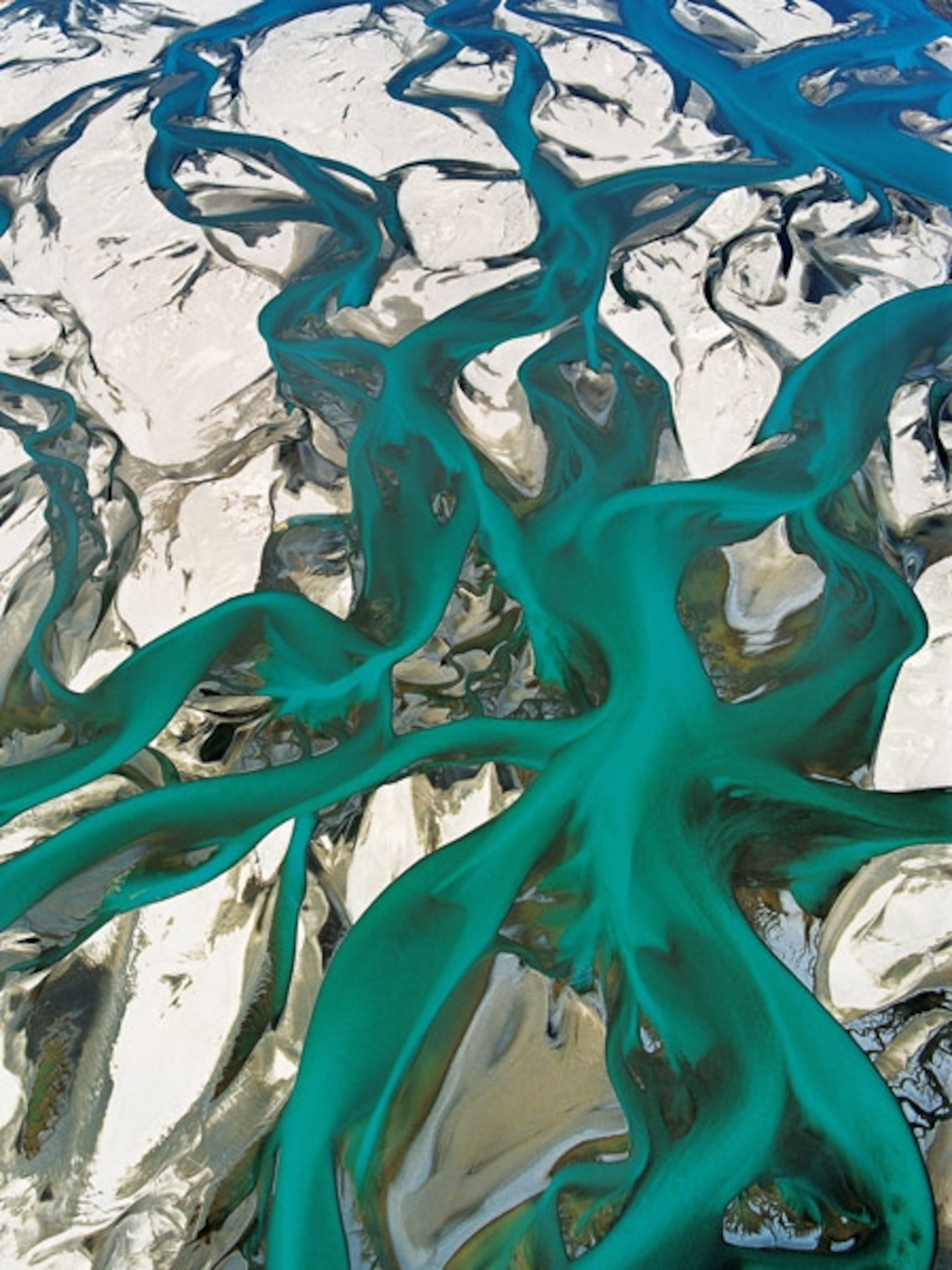
Ribbonlike branches of the Brahmaputra River—known in China as the Yarlung Tsangpo River—flow from Tibet’s Himalaya mountain range into India. The Tibetan Plateau’s lockbox of snow and glacial ice supplies freshwater to nearly a third of the world’s people.
-
Jiuzhaigou Nature Reserve
Photograph by Michael S. Yamashita
Crystal pools glisten among drifts of mist in China’s Jiuzhaigou Nature Reserve, high in the mountains of Sichuan Province. In an ancient love story, a Tibetan god gave a mirror polished by clouds and wind to a goddess, who dropped it. Shards scattered, forming Jiuzhaigou’s 118 lakes.
-
Chang Tang, Tibet
Photograph by Galen Rowell
An expedition member hauls a custom-built rickshaw laden with supplies across the desolate Chang Tang alpine steppe in northern Tibet. In 2002 a group of elite mountaineers put together the expedition to witness births at the remote calving grounds of the elusive chiru, or Tibetan antelope.
-
Tibetan Dance, Shangri-La
Photograph by Steve Gu, My Shot
Locals participate in Tibetan folk dancing in Shangri-La, located on the edge of the Tibetan Plateau in Yunnan Province. In the city’s Culture Square, music blares nightly from loudspeakers. The dancers’ rings of clockwise motion echo spinning prayer wheels.
-
Red Lanterns, Old Town Lijiang
Photograph by Andrea Pistolesi, Getty Images
Red lanterns decorate homes above a canal in the Old Town of Lijiang in Yunnan Province. The city’s well-preserved historic area became a UNESCO World Heritage site in 1997.
-
Blessing, Guizhou Province
Photograph by Lynn Johnson
A blessing written on red paper celebrates the birth of a baby in the village of Dimen in Guizhou Province. The community of over a thousand is home to the Dong people, whose five clan villages grew together to form Dimen.
More Travel Photo Galleries
Shop National Geographic
Top Picks for Travel
- Enter Now! Traveler Photo Contest
- NEW! Best of the World Weekly
- Call for Nominations: Travelers of the Year
- How to Become a Nat Geo Photographer
- Top 10 Islands
- Don George's #TripLit Pick for June
- Download City Guides App
- Photos: Galicia, Spain
- Photo Gallery: World's Best Ecolodges
- Tips for Traveling Couples
Advertisement
Our Trips
2013 Traveler Photo Contest
-
Share Your Best Travel Photos
Enter to be featured in our weekly galleries and win a grand prize trip to the Galápagos.