-
Photograph by Sisse Brimberg & Cotton Coulson, Keenpress
The wooden windmills of Saaremaa island, located near the town of Leisi, have become a popular tourist attraction and the symbol of this, Estonia's largest island. "From Saaremaa, a breed of tough seafarers once harassed Viking cities in Sweden," says Priit Vesilind, author of "Up from the Ruins" in the November/December 2007 issue of National Geographic Traveler. "One of the best preserved medieval castles in northern Europe squats in Kuressaare, the island's capital. Saaremaa once relied on fishing and boatbuilding, but the island was the westernmost point of land in the U.S.S.R., thus a frontier area with missile sites. Westerners as well as most Estonians were barred. But, in the isolation, nature restored itself. Saaremaa now has several nature preserves."
Read more about Estonia in "Up from the Ruins" in the November/December 2007 issue of National Geographic Traveler.
-
Photograph by Sisse Brimberg & Cotton Coulson, Keenpress
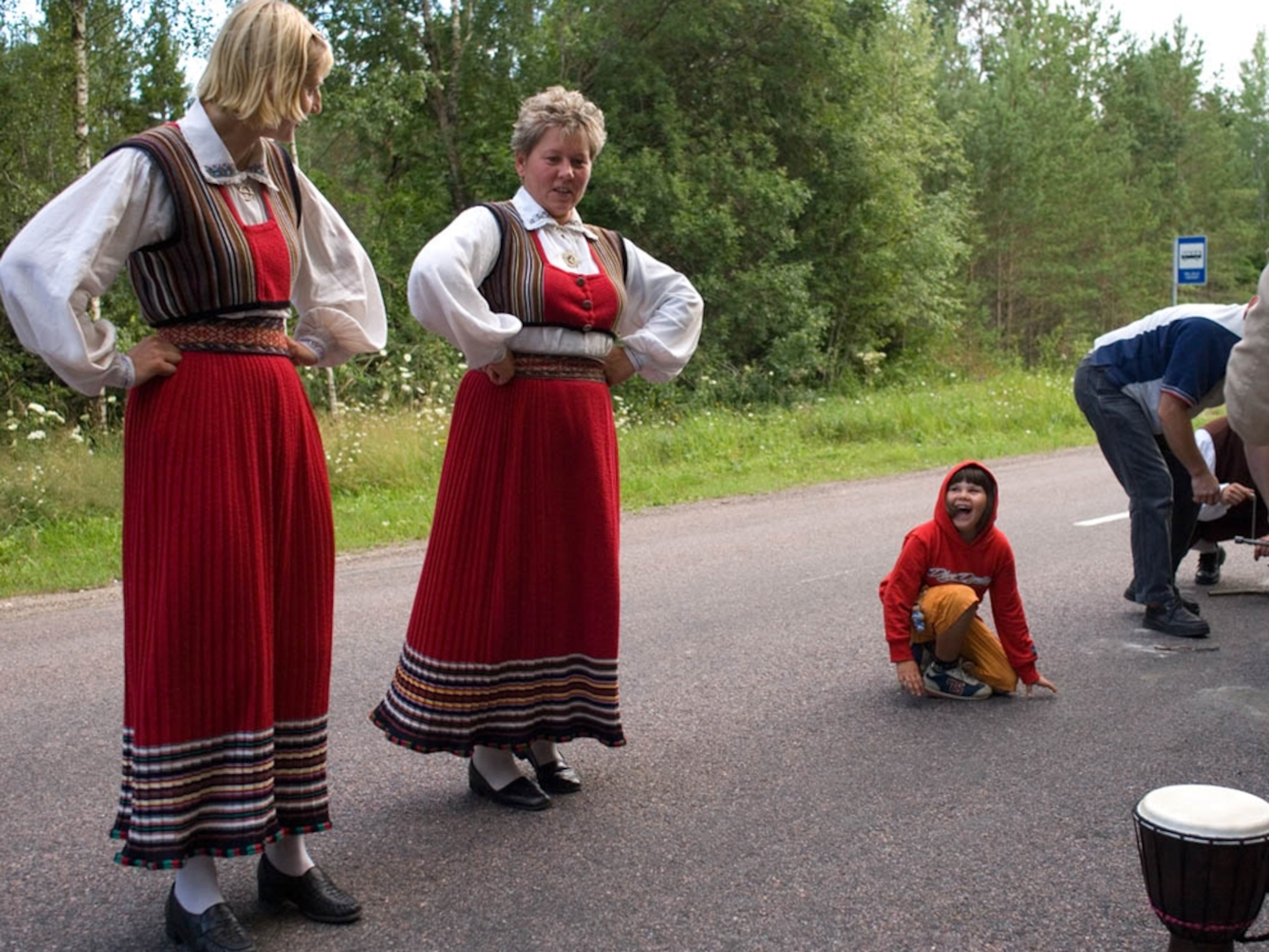
A group of Estonian dancers stops along a road on Saaremaa island to help a Finnish family change a flat tire. As the men work on the car, two women in traditional dress take the opportunity to practice their dance steps in the road. "Estonia is about the size of Switzerland," says Vesilind, "but its landscape is calm, on a human scale. It has no mountain peaks, raging rivers, or spectacular fjords. You can't get badly lost here. Drive anywhere for more than a few hours and you'll run into the sea or into Russia or Latvia."
Read more about Estonia in "Up from the Ruins" in the November/December 2007 issue of National Geographic Traveler.
-
Photograph by Sisse Brimberg & Cotton Coulson, Keenpress
Tourists in front of Tartu's City Hall, built in 1789, are inspired by the pose of the fountain's sculpture, which depicts a young couple embracing under an umbrella, defying traditionally stoic Estonian style. "Estonians are known as cool and rational, not given to quick emotions," says Vesilind. "If you smile too much people will think you're overly familiar, or a bit daft. But there's no phoniness to most Estonians, and they make fast friends." Tartu is Estonia's second largest city, after the capital, Tallinn. The city is known for its Art Museum, which leans precariously to one side due to its faulty foundation.
Read more about Estonia in "Up from the Ruins" in the November/December 2007 issue of National Geographic Traveler.
-
Photograph by Sisse Brimberg & Cotton Coulson, Keenpress
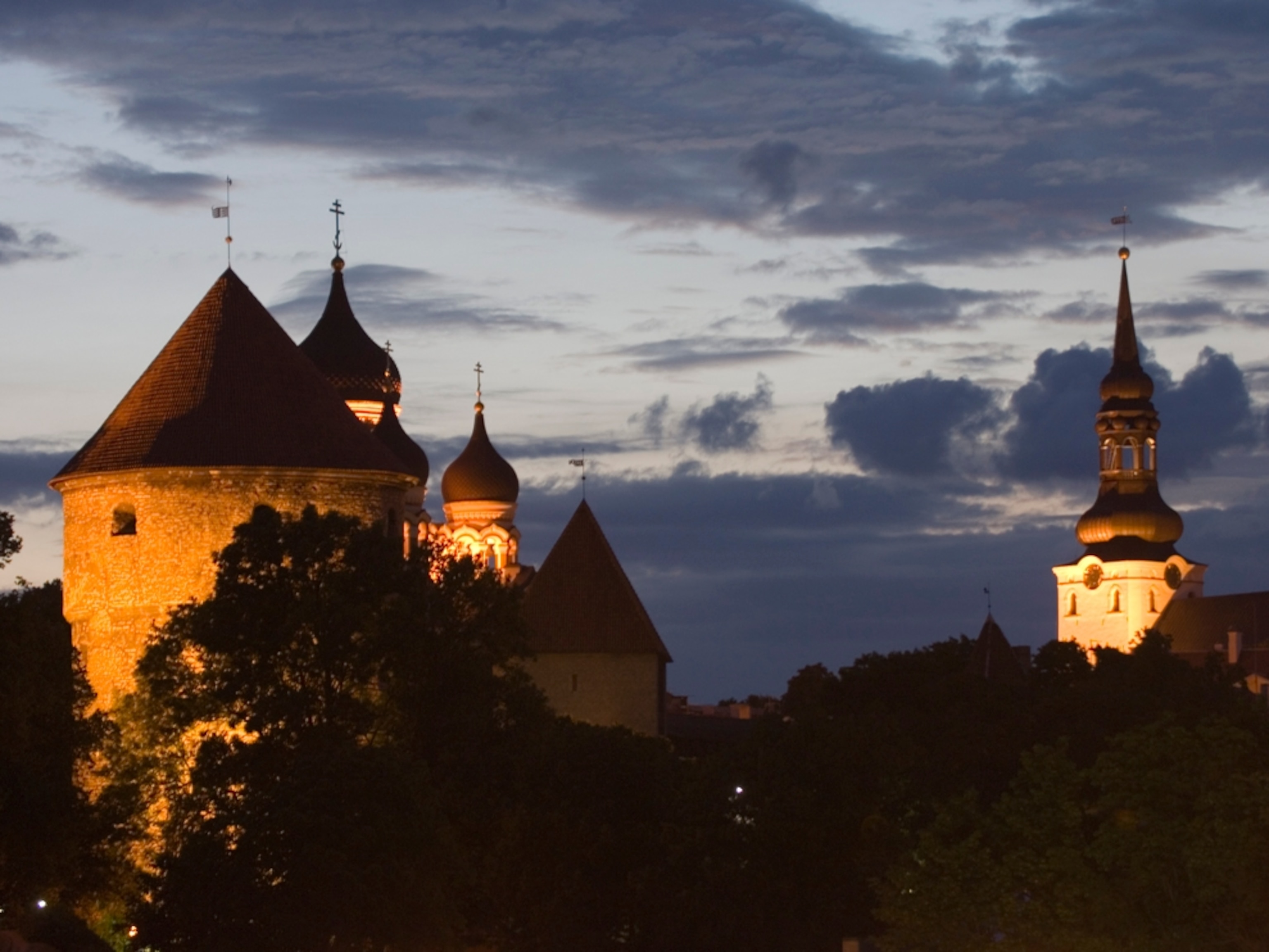
Lights bathe Tallinn's famous Kiek in de Kok Tower, at left, in the city's Old Town. Alexander Nevsky Cathedral, with its Russian onion domes, stands to the right. The nearby Cathedral of St. Mary the Virgin (Toomkirk) was built by the Danes after the Danish invasion of Estonia in the early 13th century. During long periods of occupation over eight centuries, "Estonians themselves were little more than serfs," according to Vesilind. "They enjoyed independence for 20 years between world wars. Now once more independent, this former republic of the U.S.S.R. on the eastern shore of the Baltic Sea has joined both NATO and the European Union, and rejoined the European mainstream."
Read more about Estonia in "Up from the Ruins" in the November/December 2007 issue of National Geographic Traveler.
-
Photograph by Sisse Brimberg & Cotton Coulson, Keenpress
In Tallinn's Old Town, a waitress serves patrons at the medieval restaurant Olde Hansa. Founded by Danes in 1219, the historic heart of Tallinn is now a UNESCO World Heritage site. "For centuries, the stout towers and thick walls that still encase most of Old Town protected the merchants of the Hanseatic League, a medieval network of European cities," says Vesilind, explaining that Estonians "have endured occupiers for the past 800 years—Teutonic knights, Danish and Swedish conquerors, Russian tsars, German Nazis, as well as the Red Army. All left their grand designs and detritus behind. Old Tallinn looked much the same in 1944, when my family and I fled Estonia as the Red Army of the Soviet Union arrived to occupy it for the following 48 years."
Read more about Estonia in "Up from the Ruins" in the November/December 2007 issue of National Geographic Traveler.
-
Photograph by Sisse Brimberg & Cotton Coulson, Keenpress
Young Estonians gather on Friday night after work to have a drink in one of the hip, youth-oriented bars in Old Tallinn. "In the 1990s," Vesilind explains, "Estonia virtually catapulted into the world of market capitalism, computers, and wireless technology, bypassing decades of development. Eager to make up for lost time, the Estonian people built new enterprises by integrating them into the old. They converted old farms into guesthouses, manor houses into spas, hotels, and convention centers. They turned old armories into beer pubs, and Soviet-era factories into art galleries. They knew that the past was part of who they were."
Read more about Estonia in "Up from the Ruins" in the November/December 2007 issue of National Geographic Traveler.
-
Photograph by Sisse Brimberg & Cotton Coulson, Keenpress
At Parnu beach, a young girl and her mother walk their dog. Situated along the Baltic Sea on Parnu Bay, in southwestern Estonia, Parnu is a popular summer vacation resort, with many hotels, restaurants, and beaches. "Parnu has been a beach resort for generations of Estonians and Russians on the Gulf of Riga," says Vesilind. "In Soviet times a group of factory workers from, say, Minsk, might be awarded a week of treatment time at Parnu's therapeutic mud baths." The author's son, Bill, describes the city as "the center of summer fun for young people. Good beaches, music festivals, good parties."
Read more about Estonia in "Up from the Ruins" in the November/December 2007 issue of National Geographic Traveler.
-
Photograph by Sisse Brimberg & Cotton Coulson, Keenpress
A guest enjoys breakfast—and canine companionship—at Padaste Manor on the island of Muhu. "Imre Sooaar and his partner, Martin Breuer, have created Estonia's most luxurious small resort hotel and spa," says Vesilind. "They've recast the solid stone-and-timber carriage houses into elegant guest rooms and restaurants. A broad lawn slides to the sea under a canopy of leafy saar trees. Padaste grows its own salad greens and vegetables, and makes big use of local produce." Says Martin Breuer: "Our guests don't come here for the high life, or to impress other people. You go to the Côte d'Azur to do that. To come to Estonia is to be connected to nature and to the folk traditions."
Read more about Estonia in "Up from the Ruins" in the November/December 2007 issue of National Geographic Traveler.
Shop National Geographic
Top Picks for Travel
Advertisement
Our Trips
2013 Traveler Photo Contest
-
Share Your Best Travel Photos
Enter to be featured in our weekly galleries and win a grand prize trip to the Galápagos.