-
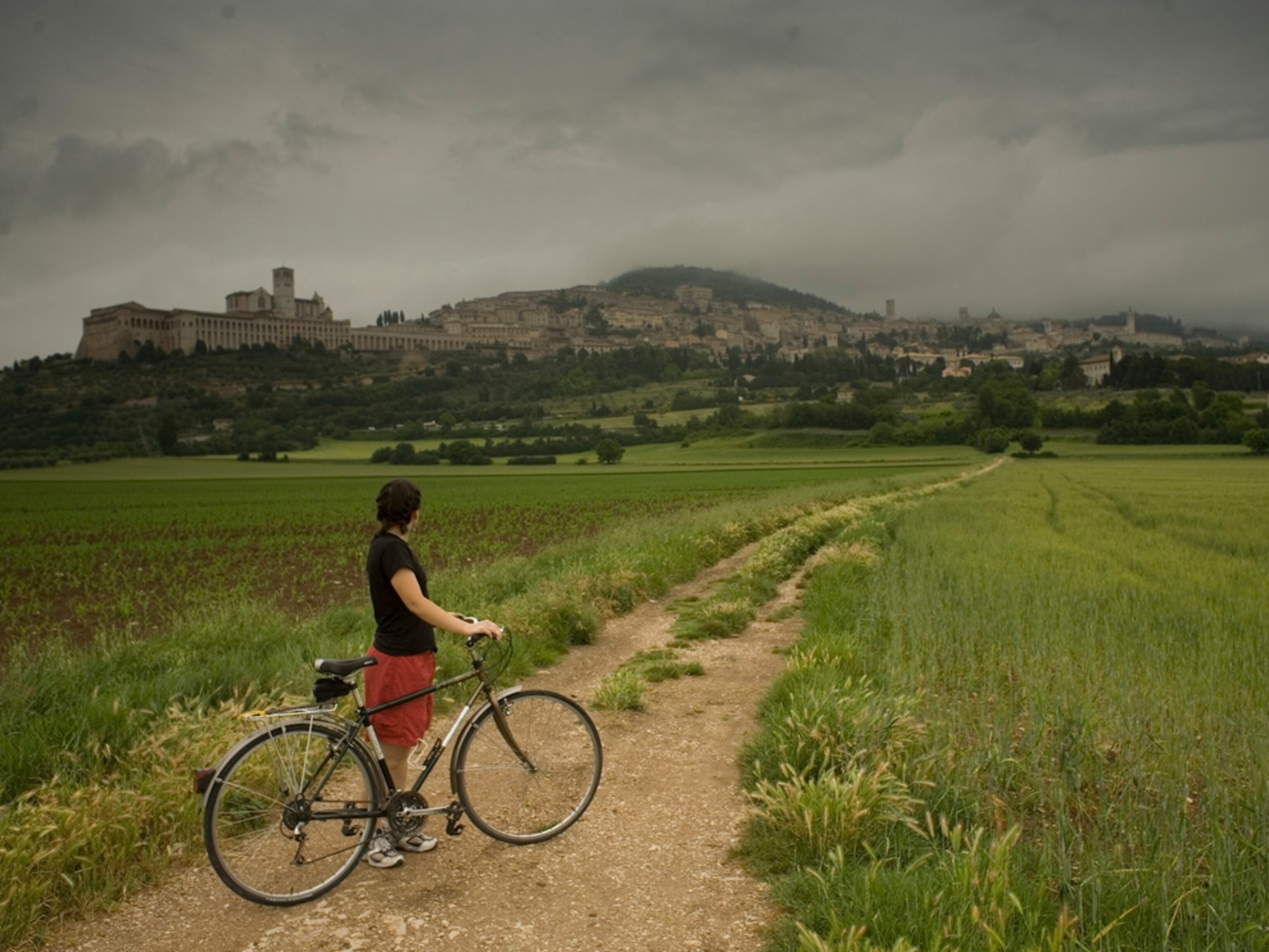
Photograph by Aaron Huey
Like a promised land, the medieval town of Assisi rises from an Umbrian valley. "I took this photo on a very rainy day," says photographer Aaron Huey. "Half of the Blue Marble group was still riding through a storm farther down the valley." The Monastery and Basilica of St. Francis—which contains the saint's tomb—dominate the left flank here, backdropped by the town of Assisi. Consistent with its spiritual character, Assisi and its surroundings offer visitors a range of accommodations in monasteries and convents.
Read more about this region of Italy in "Shifting Gears" in the July/August 2007 issue of National Geographic Traveler.
-
Photograph by Aaron Huey
The brown robes of the religious order of St. Francis of Assisi distinguish Father Ruff, a monk who has lived at the Assisi monastery for 27 years. "I love this frame," says Huey, "because of the graphic qualities of the angles and the different patterns of the stonework." The birthplace of St. Francis, Assisi has been a prominent Catholic pilgrimage site for centuries. Its religious importance also attracted some of Italy's greatest artists, including, in the Middle Ages, the master painters Giotto and Cimabue, who graced the Gothic Basilica of St. Francis with richly colored frescoes. In September 1997, earthquakes rocked the town, killing ten people and significantly damaging the basilica's fresco-covered upper ceiling. Eight years of repairs have largely restored the damaged sections, which are again open to the public.
Read more about this region of Italy in "Shifting Gears" in the July/August 2007 issue of National Geographic Traveler.
-
Photograph by Aaron Huey
To enter Pasticceria Sandri, in Perugia's old town, is to enter one of Umbria's oldest pastry shops. Founded more than 120 years ago by a Swiss pastry maker, the fresco-decorated shop doubles as a café and bar. "Sandri's was one of the most amazing pastry shops I've encountered in all my travels," says Huey. Popular offerings include cream-filled bigné, almond-flavored torciglione pastries, and everything chocolate—cakes to candies—an inevitability in the hometown of the famous Baci Perugina bonbons.
Read more about this region of Italy in "Shifting Gears" in the July/August 2007 issue of National Geographic Traveler.
-
Photograph by Aaron Huey
Two Italian passions—soccer and the church—converge on the piazza in front of Spoleto's Cathedral of the Assumption of St. Mary (Cattedrale di Santa Maria Assunta). The landmark cathedral dates to the 1100s and boasts a noteworthy series of 15th-century frescoes, titled "The Life of the Virgin," by Tuscan painter Fra Filippo Lippi (whose tomb lies in the cathedral). "I photographed this simple moment of locals playing soccer by the cathedral because it captures, to me, the best part of Italy," says photographer Huey.
Read more about this region of Italy in "Shifting Gears" in the July/August 2007 issue of National Geographic Traveler.
-
Photograph by Aaron Huey
A 21st-century moment in medieval garb: "These two flag bearers were taking a smoke break while participating in the annual Palio della Balestra—Competition of the Crossbow—in Gubbio," says Huey. A major annual event, the palio features crossbow-shooting contests between the teams of Gubbio and nearby Sansepolcro. Participants dress in period costumes like those seen here, which are on full display during the torchlight victory procession at the end of the festival.
Read more about this region of Italy in "Shifting Gears" in the July/August 2007 issue of National Geographic Traveler.
-
Photograph by Aaron Huey
This shot shows two of the riders on the Blue Marble bike trip—Hannah Koski, in the pearls, and author Joyce Maynard's son, Wil, with the cap—hanging out on the steps of Perugia's cathedral," says photographer Huey. "It was an awesome scene. All of the young people were drinking red wine from plastic cups—a local tradition—so we joined in."
Read more about this region of Italy in "Shifting Gears" in the July/August 2007 issue of National Geographic Traveler.
-
Photograph by Aaron Huey
Like so many flowers bursting into bloom, hand-painted plates frame a ceramics shop in the ancient town of Gubbio. Umbria and Tuscany are famous for their distinctive, handcrafted maiolica ceramics, with Gubbio especially known for maiolica forged with a "three-firing" technique that adds a distinctive luster to the glaze. This stone-girded town, a setting for the award-winning 1968 movie "Romeo and Juliet" directed by Franco Zeffirelli, still boasts many medieval structures, including the Renaissance-style Ducal Palace, the Gothic-style Consul's Palace, and a clutch of Gothic-Romanesque churches.
Read more about this region of Italy in "Shifting Gears" in the July/August 2007 issue of National Geographic Traveler.
-
Photograph by Aaron Huey
Color guard: A young sbandieratore—flag waver—struts his stuff in Assisi, one of several Italian towns that field sbandieratore teams. The teams compete in medieval-style festivals that often include crossbow competitions and pageants. "The flags in this photo show the symbols of Assisi," says photographer Huey. The sbandieratori compete by showing how well they wield and throw their flags. In a dramatic finale, they take turns jumping over prostrate teammates while holding their flag under their legs. "Making these shots, I got so close to the competitors that the audience probably thought I was part of the troupe."
Read more about this region of Italy in "Shifting Gears" in the July/August 2007 issue of National Geographic Traveler.
-
Photograph by Aaron Huey
I don't usually photograph cheese plates," says shooter Huey, "but this spread at the wine bar/café Enoteca l'Alchimista, in the village of Montefalco, was one of the culinary highlights of the whole biking trip. I've never had a cheese plate creep into my conversations, but for weeks after the trip, this one did. I bet I could call the others who were on the trip right now and ask if they remember 'that cheese plate in Montefalco,' and they would smack their lips. It was that good." Umbria is known for its devotion to its food traditions and for such specialties as caciotta cheese, flavored with local truffles; prosciutti di montagna (mountain prosciutto); and olive-based foodstuffs, including gourmet olive oils and olive pastes. It is also known for its traditional flat breads—focaccia or schiacciata—and for its white wines from around Orvieto. Recently, some notable Umbrian reds, such as the Torgiano Rosso Riserva and Montefalco's own Sagrantino, have been garnering international praise and awards.
Read more about this region of Italy in "Shifting Gears" in the July/August 2007 issue of National Geographic Traveler.
-
Photograph by Aaron Huey
This shot is of the final ride of our Blue Marble tour," says Huey, "coasting down a hill toward Lake Trasimeno. The hills were blooming with yellow Spanish broom, a common sight in Italy and a perfect home stretch for the trip." Trasimeno, Italy's fourth-largest lake (after the northern lakes of Como, Maggiore, and Garda), is a popular weekend destination for Umbria's city dwellers, who come to dine on fresh lake fish and local truffles by Trasimeno's blue waters. It also is an important birding area, home or a stopover point for everything from cormorants to herons, grebes, and ospreys.
Read more about this region of Italy in "Shifting Gears" in the July/August 2007 issue of National Geographic Traveler.
Shop National Geographic
Top Picks for Travel
Advertisement
Our Trips
2013 Traveler Photo Contest
-
Share Your Best Travel Photos
Enter to be featured in our weekly galleries and win a grand prize trip to the Galápagos.