-
Photograph by Andrew H. Brown
A black bear, with her cub at her feet, leans into the window of a tourist's automobile. Other tourists stop along the park road, with camera in hand, eager to record the scene.
-
Photograph by William Henry Jackson
Original William Henry Jackson photograph from the Hayden Survey collection at the U.S. National Archives. Taken in 1875 during the expedition to explore the American West led by Dr. Ferdinand Hayden for the U.S. Geological Survey. Jackson was a photographer for the survey from 1870 to 1878.
"Photographs of the miraculous—of bubbling cauldrons, clockwork geysers, and bridal-veil falls—helped convince Congress in 1872 to set aside a Wyoming wilderness larger than Delaware. Yellowstone, the first national park anywhere, had few visitors at first; last year [1978] there were 2,600,000."
—Originally published in "A Long History of New Beginnings," National Geographic magazine, July 1979
These days the park has roughly three million visitors a year.
-
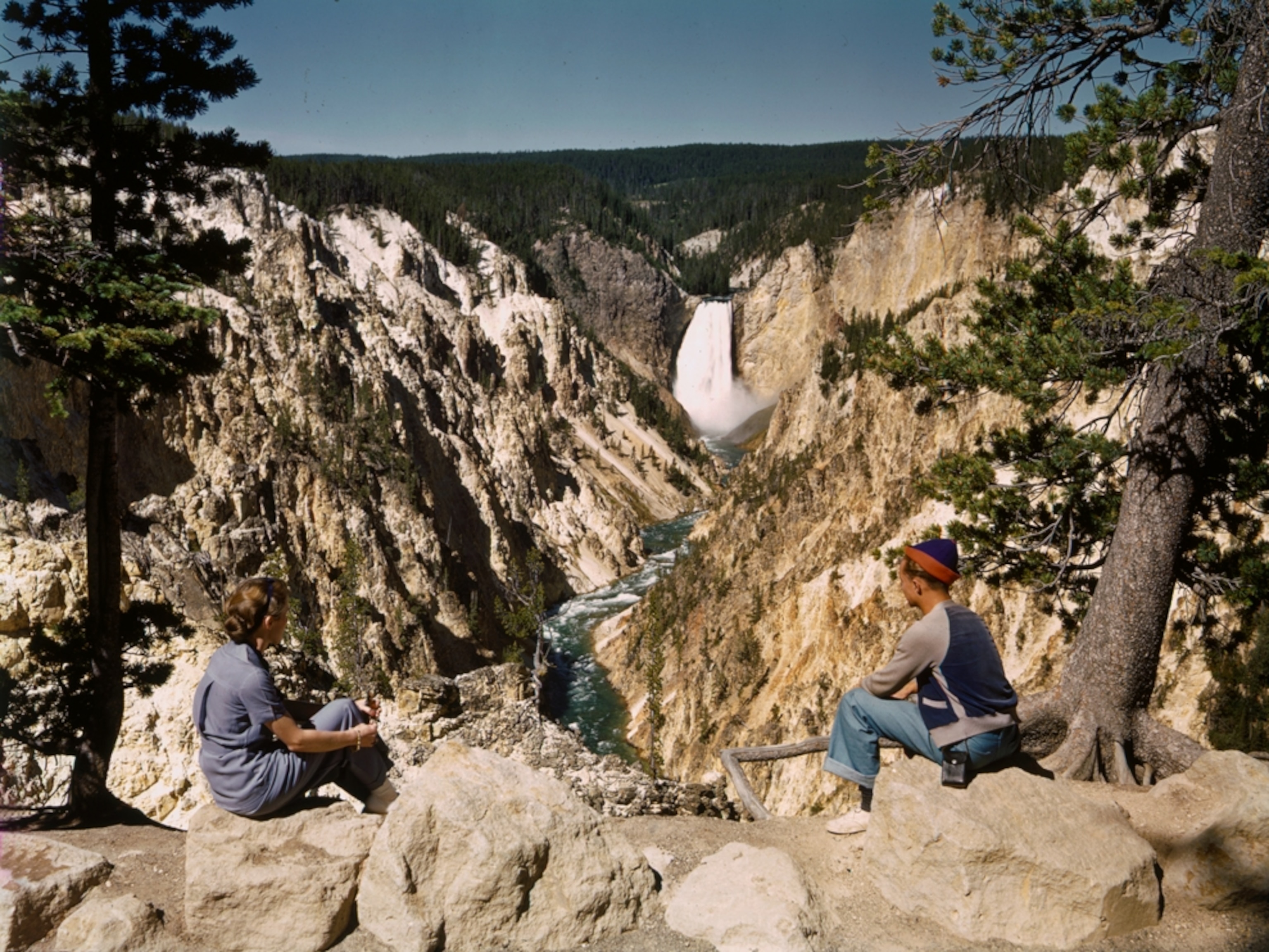
Photograph by Edwin L. Wisherd
"Why They Call It the 'Yellowstone'—Grand Canyon and Lower Falls from Artist Point: The colors come largely from oxides of iron in the rhyolite, a lava rock. Nearly a mile away the river leaps over a 308-foot cliff, and even here its roar is heard. Hot springs and steam jets, softening the rock, helped the river to carve the canyon. Some are still active, deep in the golden gorge."
—Originally published in "Fabulous Yellowstone," National Geographic magazine, June 1940
This photo was taken using Kodachrome film. Click here to read about the history of Kodachrome and National Geographic.
-
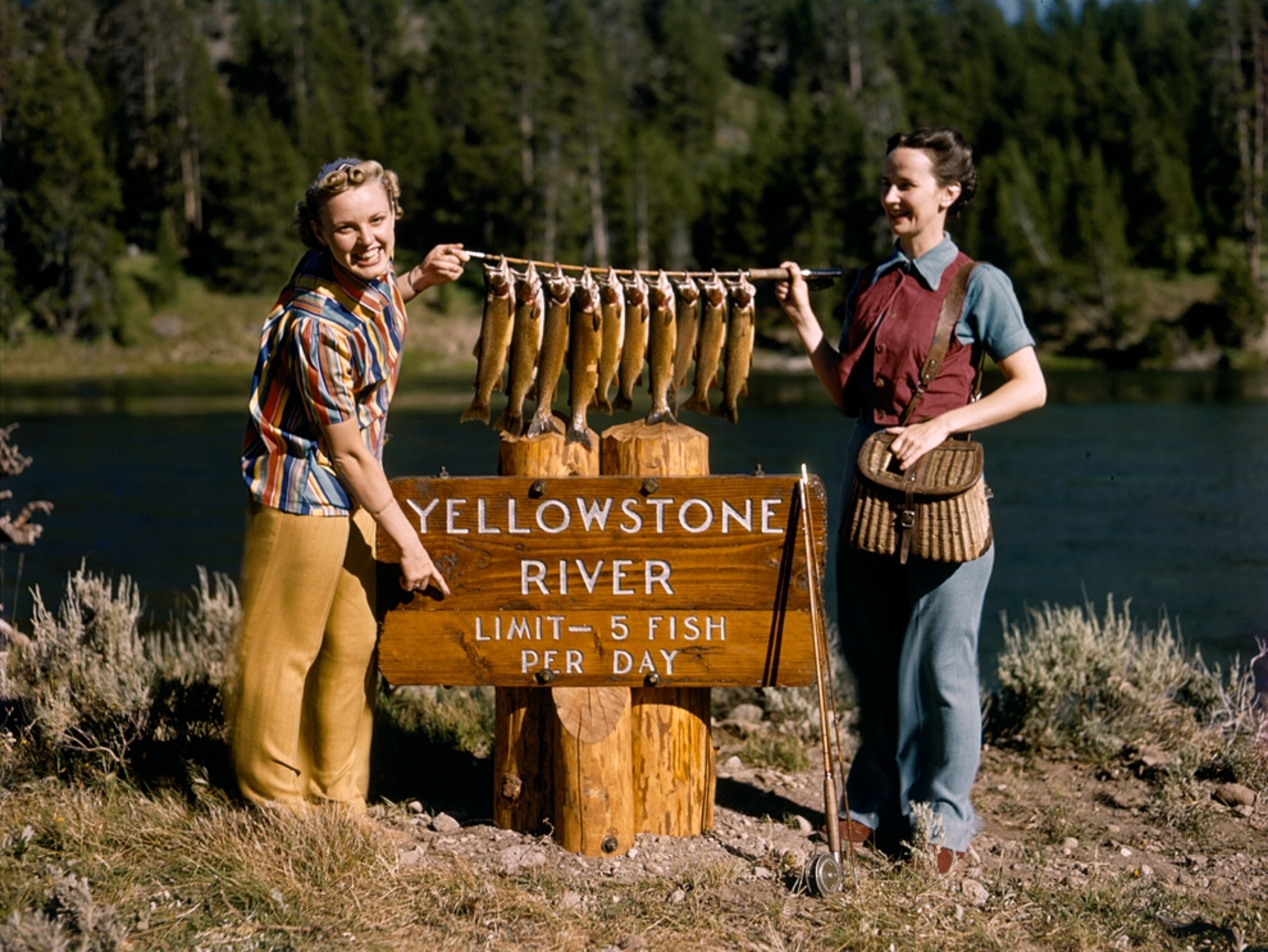
Photograph by Edwin L. Wisherd
"'Ten—Count 'em—Ten! We've Caught Our Limit!': Of these twelve beauties the ones on the rod are the native Yellowstone trout, called 'cutthroats' for the red slash near the gills."
—Originally published in "Fabulous Yellowstone," National Geographic magazine, June 1940
-
Photograph by Annie Griffiths Belt
The sun rises over the Hayden Valley and the Yellowstone River.
—Originally published in "The Yellowstone: The Last Best River," National Geographic magazine, April 1997
-
Photograph by William Henry Jackson
This original William Henry Jackson print (ca. 1870-1878) is held in the collection of the Colorado Historical Society.
-
Photograph by Sam Abell
This previously unpublished photo was taken during a backcountry expedition through Yellowstone, which was covered in "Yellowstone at 100: A Walk Through the Wilderness," written by sister-brother team Karen and Derek Craighead for the May 1972 issue of National Geographic. Karen called their outing "a quest for the unspoiled and the unseen."
-
Photograph by William Albert Allard
"Speedsters rocket across the snow. Pronghorns, popularly called antelope, will race anything—including helicopters. They can run 50 miles an hour for a stretch and cruise easily at 30...Buff-and-cream coats blend with Yellowstone's shrub and snow terrain in a frieze of frozen motion."
—Originally published in "Yellowstone Wildlife in Winter," National Geographic magazine, November 1967
-
Photograph by O. Louis Mazzatenta
Bison drink from a pond in a snow-covered Yellowstone National Park.
-
Photograph by William Albert Allard
"Open rooftops give visitors an unobstructed view of snowy slopes and animal herds."
—Originally published in "Yellowstone Wildlife in Winter," National Geographic magazine, November 1967
-
Photograph by William Albert Allard
"Yellowstone Wildlife in Winter," an article from the November 1967 issue of National Geographic magazine, included information about these snowmobile vehicle tours: "Along the Lower Geyser Basin we waved at sightseers standing beside the tanklike snowmobiles that had brought them over the snowbound road from West Yellowstone. The day is perhaps not far off when large number of visitors, bundled up in snowmobiles, will see much more of the park's winter beauty. When that day comes, fleets of steel-treaded half-tracks will rumble across a land that once knew only the snowshoes of Indians and trappers."
This is the first time this photo has been published.
-
Photograph by William Henry Jackson
This original 1872 William Henry Jackson photograph from the Hayden Survey collection of the U.S. National Archives documents Major Pease's ranch. Pease was an agent for the Crow Native American tribe, and his namesake, Fort Pease, constructed in 1875, was the first attempted European settlement of the Yellowstone Valley—Native Americans had already been living there for 11,000 years.
-
Photograph by William Albert Allard
Night falls around what was then Ranger Gary Brown's home.
—Originally published in "Yellowstone Wildlife in Winter," National Geographic magazine, November 1967
Today, this structure serves as the Lamar Ranger Station, which provides housing for the Lamar ranger and emergency visitor services. Built near the turn of the century, it is on the National Register of Historic Places.
-
Photograph by Andrew H. Brown
"A sight-seeing cavalcade led by a bus from Yellowstone's famous yellow fleet threads the Hoodoos, stark blocks of ancient travertine that tumbled from Terrace Mountain, three miles south of Mammoth Hot Springs."
—Originally published in the National Geographic book America's Wonderlands: the Scenic National Parks and Monuments of the United States, 1966
-
Photograph by Sam Abell
Nuns are among the tourists visiting Yellowstone's famed Fountain Paint Pots in this never-before-published 1971 photo.
Click here for information on the Fountain Paint Pots Nature Tour.
-
Photograph by William Albert Allard
"A favorite sight, Old Faithful (left) steams beside the Firehole River. Visitor and ranger facilities wear snow caps; to the north sparkle distant Montana peaks."
—Originally published in "Yellowstone Wildlife in Winter," National Geographic magazine, November 1967
-
Photograph by Paul Zahl
"Near Yellowstone's steaming geysers, primitive blue-green algae grow in hot springs, enduring water temperatures as high as 160°F."
—Originally published in "Algae: the Life-Givers," National Geographic magazine, March 1974
-
Photograph by James P. Blair
"Ghost in misty vapors, Will Gray trails his family through steaming vents and hot springs of Norris Geyser Basin at Yellowstone National Park."
—Originally published in America's Wonderlands: the Scenic National Parks and Monuments of the United States, 1966
-
Photograph by Edwin L. Wisherd
"Quiet Little Beach Spring Suddenly Boils and Becomes a Geyser: To a group on a 'geyser hike' near Old Faithful, Ranger Naturalist Harry Truman [not the president] points out this dual-personality pool which last summer [1939], for the first time in its recorded history, started to erupt."
—Originally published in "Fabulous Yellowstone," National Geographic magazine, June 1940
-
Photograph by Dean Conger
"'Bread for a hungry bruin?' Blond bear begs in Yellowstone, but children obey park rules: Don't open windows or offer food."
—Originally published in "The Mission Called 66: Today in Our National Parks," National Geographic magazine, July 1966
Shop National Geographic
Advertisement
Our Trips
2013 Traveler Photo Contest
-
Share Your Best Travel Photos
Enter to be featured in our weekly galleries and win a grand prize trip to the Galápagos.